
ThesisTrust leads to volume
Our claim is that people move more money, and move it more often, when it is easy to know who they are paying and frictionless to transaction. Every payment platform that reached serious scale got there by answering that question for the sender. Branta brings that confidence to crypto by putting a verified business name and logo inside the wallet, before the transaction is signed, before funds ever leave the sender’s control. And if the last thirty years of payments history are any guide, what follows is higher completion rates, happier customers, more repeat usage, and a real jump in total volume across Bitcoin, Lightning, and stablecoins.
Convenience never created the great waves of payment volume we now take for granted. Confidence did.
The sections below trace that pattern from paper checks through PayPal, Venmo, Cash App, and Zelle, then map it onto crypto as it stands today. A verification layer at the moment of send is what on-chain payments need before they can carry the volume they’re forecast to. By upgrading the UX of wallet applications to match the needs of users, payment volumes across crypto rails will reach new heights.
Part oneThe pattern behind every payments boom
The history of digital payments is not really a story about speed, it is a story about trust. Each new rail won because it removed the specific anxiety that made people hesitate at the moment money changed hands, and being faster was almost a side effect. When that hesitation fell away, volume did not grow in a straight line, it compounded.
To see the pattern clearly, start before the rails existed, back when paying another person meant handing over cash or writing a check, and commerce moved at the speed of trust between people who usually had no easy way to verify one another.
The baseline: cash, checks, and the IOU
For most of the twentieth century, if you needed to pay someone back in person you only had two options: Cash or checks. If you opted for check you had to: fill it out by hand, deliver it, hope it clears, hope it doesn’t bounce. The system worked at genuinely enormous scale with Americans writing more than 40 billion checks a year at the turn of the century, more than all card and electronic payments combined. Additionally, check volume doubled every decade after World War II, from about 8 billion items in 1970 to 16 billion by 1980. However, it doubled out of necessity and because there was simply no better way to move money at a distance, not because people loved the product.
Once better options arrived, check volume fell fast. By 2021 the U.S. was down to roughly 11 billion checks a year — about 5% of noncash payments — and by 2024 more than 90% of consumers said they’d rather pay with almost anything else.
Cash had its own ceiling. It required physical presence, exact change, and a shared assumption of safety that broke down the moment amounts got large or the parties were strangers. The friend who covered dinner while another promised to “get the next one” was opting for a loophole called “the IOU” as a workaround for the total absence of any easy way to settle a small debt on the spot. It persisted for decades because the rails to replace it didn’t exist yet.
Enter the .com era and the proliferation of software.
PayPal: the first name at checkout
The first rail to break the pattern at scale was PayPal, and it won by solving a trust problem. Speed had almost nothing to do with it. In early online commerce, buyers and sellers who had never met needed to exchange money without handing a stranger a card number, and PayPal planted itself in the middle as the party both sides could trust. That position let it grow alongside the internet itself capturing about $145 billion in total payment volume by the end of 2012.
PayPal also made one design choice at the moment of payment that matters for everything that follows: it showed the payer the name of the business or person receiving the money. An anonymous transfer became a recognizable transaction, and the sender had a reason to hit confirm. It became a self-fulfilling cycle where when more people successfully onboarded and used PayPal, more people sent digital transactions seamlessly, and more people came to PayPal to repeat this cycle.
Venmo, Cash App, Zelle: the P2P explosion
The next iteration of peer-to-peer payment software came via the development of mobile applications with one focus in mind: remove friction at the point of payment for mobile devices. By building on devices everyone uses daily and making the UX extremely simple and trustworthy, payment volume across these apps grew exponentially.
Venmo is the cleanest example: its volume grew roughly a hundredfold in under a decade.
Venmo’s design choice is the one that matters here: it made the identity of the counterparty the center of the experience. Names, faces, a social feed. Paying someone felt less like wiring funds into a void and more like handing cash to a person you recognized. Cash App followed the same playbook as Venmo and saw $283 billion of inflows in 2024, a record $6.3 billion in gross profit in 2025.
Zelle tells the same story from the opposite end of the market. Built by banks, embedded straight into banking apps, it arrived years late and grew faster than everyone due to the underlying infrastructure and legacy trust it was built on top of. It crossed $806 billion in 2023, broke $1 trillion in 2024, and cleared $1.2 trillion in 2025, averaging $3.4 billion moving every single day. Banks could grow that fast because Zelle showed the recipient’s name, pulled from a real bank record, before the sender confirmed. Instead of trusting a new software company like Venmo, users simply had to turn on Zelle inside their legacy bank account. That single reassurance was enough to make people comfortable sending rent and other payments.
Across all four platforms, the common thread was a name the sender could recognize and trust at the moment of payment with a frictionless and fast transaction.
Part twoWhat actually drove adoption
If convenience were the whole story, the rail with the lowest fees and fastest settlement would win every time. It does not work that way. The products that reduced anxiety kept beating the ones that only saved seconds. What decides the outcome happens in the few moments between deciding to pay and confirming the payment, when the sender’s doubt either gets resolved or kills the transaction.
We know exactly how expensive that doubt is, because e-commerce has been measuring it for years. Baymard Institute’s checkout research found the average large online store can win a 35.26% increase in conversion through better checkout design alone scaling to roughly $260 billion in recoverable orders across the US and EU. And trust is one of the biggest leaks: security concerns drive about a quarter of checkout abandonments, 19% of shoppers have walked away because they didn’t trust the site with their payment details, and well-placed trust signals at the decision point have cut abandonment by up to 30%.
PayPal answered that question with a recognizable merchant name. Venmo and Cash App answered it with a social identity. Zelle answered it with a bank-verified name. In every case, the answer arrived before the sender committed to a transaction. The friction was psychological instead of mechanical, and the products that won were the ones that resolved it in real time.
Part threeCrypto today looks like payments before the rails
Crypto right now sits roughly where P2P payments sat before Venmo and Zelle: technically capable of moving enormous value, but weighed down by an anxiety at the moment of send that suppresses how often, and how much, people are willing to transact. The anxiety is rational: the same finality that makes crypto powerful makes a mistake unforgiving.
The cost of an irreversible mistake
A crypto payment settles with finality. Once funds leave a wallet, there’s no chargeback, no recall, no support line that can claw the money back. That finality turns a small interface error into a permanent loss, and attackers have built entire industries on it. Address poisoning — seeding a victim’s transaction history with a lookalike address and hoping it gets copied — has produced losses that read like wire fraud: a single $68 million transfer of wrapped Bitcoin sent straight to an attacker, and a separate $50 million loss from one copy-and-paste mistake in late 2025. The broader numbers are worse: the FBI logged roughly $9.3 billion lost to crypto investment schemes in 2024, up 66% in a year.
But the everyday version of this risk is quieter and does more damage to volume. Most people never lose $50 million. They just send a small test transaction first. Then they wait. Refresh. Wait some more. Only then do they send the rest while plenty never get comfortable enough to send large amounts at all. That hesitation and mistrust in crypto rails caps payment volume.
The missing identity layer
The deeper problem is that a raw crypto address tells you nothing. Thirty-odd characters, no name, no logo, no signal of who controls it. The sender is left trusting a screen with no recognizable counterparty behind it. Custody has been solved — hardware wallets and institutional infrastructure protect how value is stored. Compliance has matured — identity checks guard the edges of the system. But the transaction itself, the instant money actually moves from sender to recipient, still has no verification layer.
This is the same gap PayPal, Venmo, Cash App and Zelle each closed for fiat. For crypto, it’s still wide open.
Branta closes this gap.
Part fourBranta: a name and a logo before you send
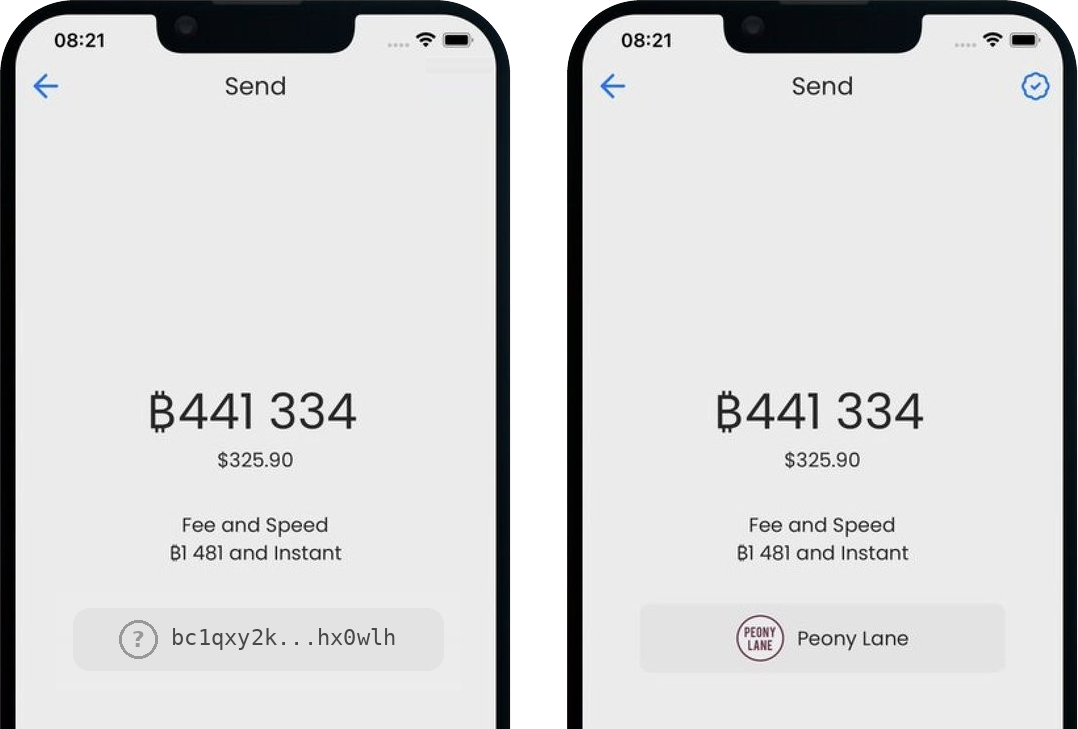
Branta closes that gap by doing for crypto what the fiat rails did for dollars: it shows the sender who they’re paying before the payment is final. When a wallet or application runs Branta, the user about to pay an invoice sees a verified business name and logo rendered right inside the wallet without leaving the app and with no extra steps. A string of characters becomes a recognizable transaction with a counterparty the sender can trust. A BOLT-11 Lightning invoice or an on-chain address renders as a branded payment screen instead of a wall of characters.
The part that makes it deployable everywhere is the architecture. Branta’s verification is zero-knowledge: it never touches keys, addresses, or payment data, and it verifies a destination without ever seeing the address being verified. There’s no honeypot of sensitive data to breach, no new liability for the wallet or the business, and no friction for the end user. Integration is a single API call or an SDK, with no runtime risk to existing infrastructure. It supports Bitcoin on-chain, Lightning, Ark, and the major stablecoins including USDT and USDC and is already live across a growing network of integrations, including a BTCPay Server plugin that puts verification in front of thousands of merchants and partnerships with payment and wallet providers moving real volume.
There’s a philosophical fit here too. Branta turns verification into something the sender can actually see: a verified identity at the point of execution, delivered privately, automatically, without asking the user to do anything differently.
But what exactly does this mean for the future of crypto payments?
Conversion
The first and most direct effect of showing a verified name and logo is that more payments get completed, and the mechanism is identical to the one that drives e-commerce conversion. A sender who can confirm, before committing, that funds are headed to the right, recognized destination completes the transaction. A sender staring at an unverifiable address hesitates, sends a test first, or bails entirely.
The fiat evidence sets a credible baseline for the size of the effect: better-resolved trust at checkout has been worth a conversion lift above 35% in large-scale testing, and trust signals placed at the decision point have cut abandonment by up to 30%. And crypto payments carry more inherent anxiety than card payments, not less, because irreversibility raises the stakes of every mistake making the upside from resolving that anxiety is plausibly larger than it is for cards. For a wallet, an exchange, or a remittance operator, every payment that would have been abandoned and instead completes is incremental revenue on infrastructure that’s already built. That’s why Branta describes verification less as a security cost and more as a conversion tool that happens to make everyone safer.
Satisfaction and retention
Confidence at the moment of payment does more than close one sale, it changes how a customer feels about the product over time, and feelings decide whether they come back. Someone who loses funds to a misdirected payment doesn’t return, and the damage rarely stops at one transaction: it torches their trust in the whole platform and usually becomes a public story that scares off others. Verification works as a retention mechanism, not just a security feature: what lets a habit form is the absence of a single catastrophic experience.
Payments businesses are built on habit. The P2P products that made sending money feel calm and ordinary became the default people reached for several times a week. A customer who braces before every send will transact as little as possible; a customer who trusts the flow will run more of their financial life through it. By giving people the same mental clarity when moving crypto that they already have when moving dollars, Branta turns one-time, cautious users into repeat, confident ones. This sets the foundation of the recurring volume that compounds into the curves charted above.
The moat
For each of these platforms, the trust upgrade did more than lift volume for a quarter, it created a competitive position that rivals spent the next decade failing to dislodge. Once a product became the place people trusted to send money, it collected network effects, habitual use, and a default position in the customer’s mind that price and speed alone could never dislodge. Venmo and Cash App became verbs and default choices to have. Zelle rode straight through the banking app customers already opened every day. PayPal turned itself into the checkout button merchants felt obligated to accept because their buyers expected it. In every case the entry point was the same, a recognizable identity at the moment of payment, and the defensibility came later, once trust turned into habit.
Crypto payments are early enough that no one holds this position yet. The layer that makes an on-chain payment feel as legible as a bank transfer is positioned to capture it, and the economics are two-sided: a verification layer becomes more valuable to every wallet as more businesses verify, and more attractive to every business as more wallets display it. That two-sided dynamic is what turned the fiat rails into defaults. Branta’s early network is the start of it, and each new integration makes the next one worth more.
There’s reason to think the position is worth more in crypto than the fiat comparison suggests, because the customers this upgrade attracts spend more. A cross-merchant study of more than fifty thousand shoppers found that customers who chose to pay with Bitcoin generated nearly 3× the lifetime value of everyone else at the same stores, spent about 38% more on their first purchase, and were roughly 50% more likely to come back for a second. They doubled as a marketing channel too, opting into brand communication at about an 84% rate despite being a privacy-conscious crowd and they kept spending above store average even in months when Bitcoin’s price fell. These are deliberate buyers who research before they commit, and when they find a business that takes their payment preferences seriously, they tend to recommend it to others. The way a business reaches and keeps this segment is by making the payment feel trustworthy and native to how they already operate. Verification at the moment of send is that kind of signal, and the businesses that add it early are best positioned to keep those customers.
Volume — Bitcoin, Lightning, and stablecoins
Everything above points at the same relationship: confidence at the moment of send comes before volume. The crypto market is positioned to test that relationship at a scale the fiat rails never reached. The base is already enormous: roughly $19 trillion settled on the Bitcoin network in 2024. And the payment-native layers are moving fast.
Stablecoins push the numbers further, because on raw settlement they already exceed the legacy card networks. Stablecoins moved about $33 trillion in 2025 — more than Visa and Mastercard combined. And the more telling detail is that transfer volume grew far faster than supply: the same digital dollars are cycling through the system more often as they get put to work on payroll, merchant settlement, and cross-border invoices. Even on conservative, payment-specific measures that strip out trading and internal routing, stablecoins carried roughly $5.7 trillion of genuine payment volume and now make up about 30% of all on-chain transaction volume. Longer-range forecasts put stablecoin payment volume on a path to rival the card networks within the decade.
The constraint on all of this growth is the same constraint that gated checks and early P2P payments: the confidence of the person about to hit send. As transaction sizes rise and less crypto-native users show up, the cost of an unverified mistake scales with the volume, and the hesitation it produces becomes a bigger and bigger tax on the network’s potential. A verification layer that removes the hesitation doesn’t just protect the volume that already exists. It unlocks the large payments that cautious users currently refuse to make and the everyday payments that anxious users currently avoid — the same lever that took Venmo from a few billion dollars of volume to hundreds of billions in under a decade.
ConclusionVolume follows confidence
Payments history keeps arriving at the same conclusion: volume follows confidence, and confidence comes from software that tells the sender who is on the other end before they commit. Checks and cash left that question unanswered. PayPal, Venmo, and Zelle answered it with recognizable names and grew into trillions of dollars of annual volume. Crypto now stands at the same threshold with the same question unanswered at the moment of send.
Branta answers it: a verified business name and logo inside the wallet, delivered privately and without friction, so an irreversible payment finally carries the reassurance that made digital fiat payments explode. The expected results are the ones this pattern has produced before: higher conversion on the payments people start, better retention among customers who never have a bad send, and, as both compound, more total value moving across Bitcoin, Lightning, and stablecoins. The rails are already carrying tens of trillions of dollars. The layer that lets people trust those rails the way they trust their bank is the difference between the volume of today and the volume the next decade is forecast to deliver.